Native Vercel integration removes friction from background job deployments. Automatic syncing and atomic deploys eliminate manual steps—here's what builders need to know.
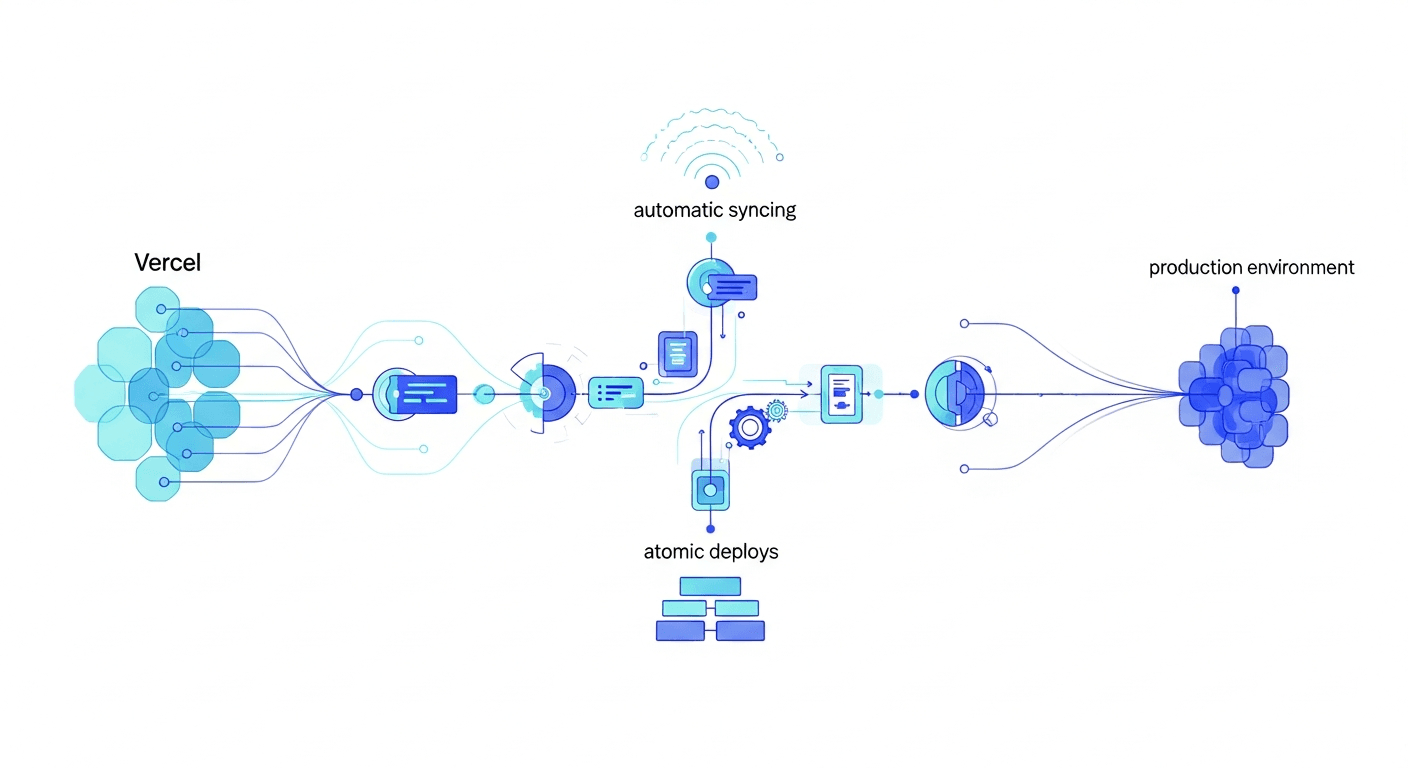
One deployment flow, one environment source of truth, zero manual sync steps—reduces deploy friction and prevents job/app code divergence.
Signal analysis
Trigger.dev now connects directly to Vercel projects, enabling three core capabilities: automatic deployment synchronization when you push code, environment variable mirroring between Vercel and Trigger.dev, and atomic deployments that ensure job definitions stay in sync with your application code.
Previously, deploying Trigger.dev jobs required manual CLI commands or custom CI/CD logic. This integration removes that layer. When you deploy to Vercel, your Trigger.dev jobs deploy simultaneously without additional configuration.
The environment variable sync matters operationally. Jobs often need access to the same secrets and configs as your app—API keys, database credentials, feature flags. This integration ensures parity automatically rather than duplicating configuration across systems.
For teams already managing Trigger.dev deployments, this integration primarily reduces toil. The manual step of running deployment commands disappears. Environment variable management becomes declarative—define it once in Vercel, it propagates automatically.
The atomic deployment aspect addresses a real production risk: job code drifting from app code. If your app updates an API contract and your Vercel deployment succeeds, your Trigger.dev jobs now update simultaneously. This eliminates the window where jobs fail silently because they're calling an outdated endpoint.
The tradeoff is integration coupling. You're now dependent on Trigger.dev's Vercel connector working correctly. If the integration breaks, you lose the automatic deployment mechanism and must fall back to manual deploys. This is acceptable for most teams but worth monitoring.
This integration is most valuable for teams already using Vercel as their primary deployment platform. If you're deploying Next.js apps to Vercel and running background jobs via Trigger.dev, this removes a step you're already taking.
If you're not on Vercel, this doesn't directly apply. However, the pattern matters: platform-to-platform integration that synchronizes code and config is becoming table-stakes. Watch for similar integrations with AWS, Railway, or other deployment platforms.
For teams with complex, multi-stage deployment pipelines (staging → production, feature branches → main), the atomic deployment model simplifies reasoning about what code is running where. This reduces debugging time when jobs behave unexpectedly.
Trigger.dev prioritizing Vercel integration signals a strategic choice: deepen the experience for teams already on modern deployment platforms rather than chase every deployment target. This is smart. Vercel's market share among Next.js builders is substantial, and that's Trigger.dev's core audience.
This also reflects the broader consolidation trend in developer tools. Single-purpose tools increasingly integrate with platform layers to reduce friction. Trigger.dev is explicitly positioning itself as 'the job platform for Vercel teams,' not 'the job platform for everyone.'
For builders, this means your tool choices are increasingly interdependent. Choosing Vercel now implicitly improves your experience with Trigger.dev, making the overall platform bundle more cohesive. This can accelerate adoption but also increases switching costs.
Best use cases
Open the scenarios below to see where this shift creates the clearest practical advantage.
One concise email with the releases, workflow changes, and AI dev moves worth paying attention to.
More updates in the same lane.
The latest Cursor update enhances AI tool integration, streamlining developer workflows and increasing productivity.
Unlock new productivity with the latest Cursor update, featuring enhanced AI tools for developers.
OpenAI's recent update introduces enhanced features that streamline developer workflows and boost automation capabilities.
