Explore the essentials of RAG system architecture, its components, implementation strategies, and best practices to build production-ready systems.
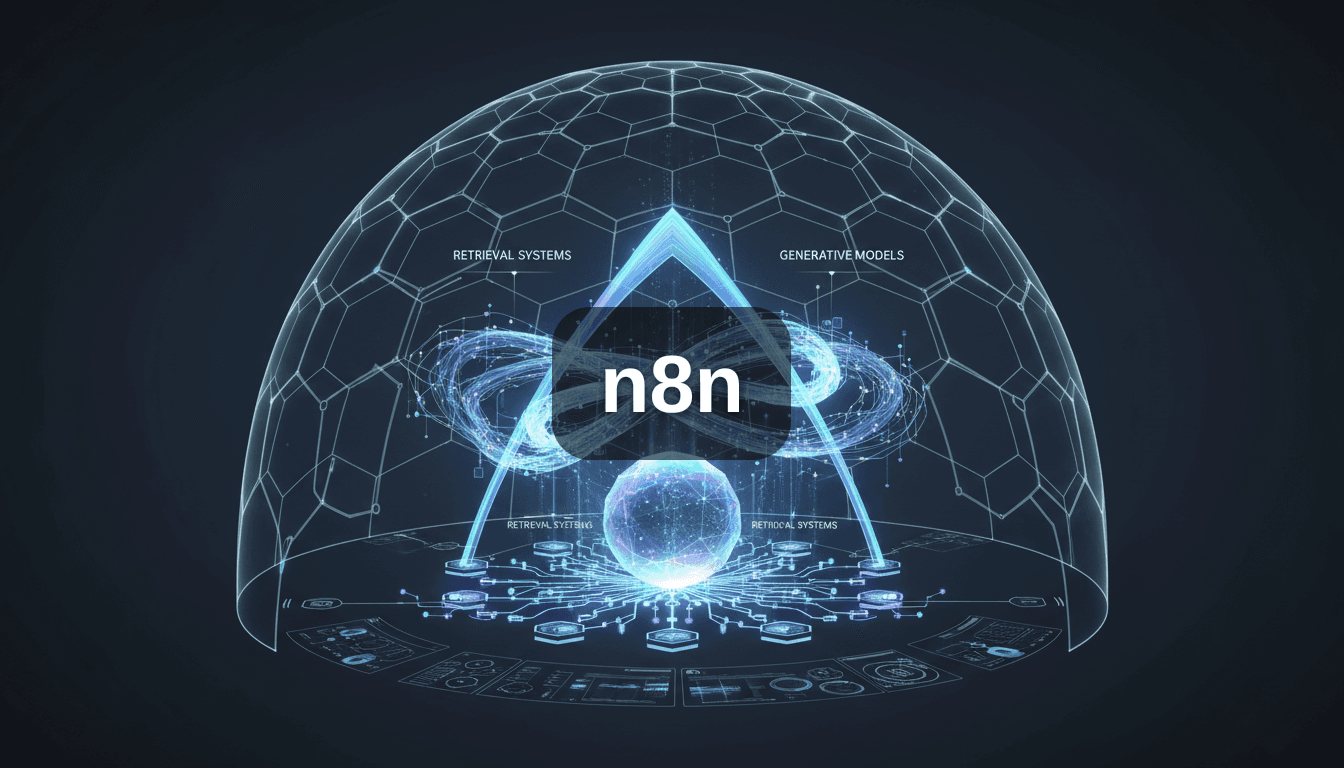
Understanding RAG architecture enables developers to build production-grade retrieval systems that avoid the common 'works in demo, fails in production' pattern afflicting AI features.
Signal analysis
Retrieval-Augmented Generation (RAG) has matured from experimental technique to production standard. Modern RAG architectures combine dense retrieval with large language models to ground responses in specific knowledge bases. This guide covers the production patterns that emerged from real deployments, avoiding the tutorial simplifications that break at scale.
The core RAG flow remains: chunk documents, embed chunks, store in vector database, retrieve on query, inject context into LLM prompt, generate response. But each step has nuances. The difference between a RAG demo and a production system lies in chunk strategy, retrieval quality, and context window management. These determine whether your system hallucinates or produces trustworthy outputs.
Architecture choices depend on your use case. Customer support bots need low latency with acceptable recall. Legal research needs high recall with acceptable latency. Code assistants need semantic + syntactic retrieval. This guide provides decision frameworks rather than one-size-fits-all solutions.
Application developers building AI features need RAG competency. Whether you're adding document Q&A to an existing product or building an AI-native application, retrieval quality determines user experience. Understanding architecture choices prevents the common pattern of 'it works in demo, fails in production.'
ML engineers transitioning to LLM applications benefit from structured RAG knowledge. Traditional ML intuitions about data quality and evaluation apply, but the patterns differ. This guide bridges ML engineering experience with LLM-specific considerations.
Technical leaders evaluating AI investments need architecture literacy. Understanding RAG tradeoffs informs build vs buy decisions, vendor evaluation, and resource allocation. You don't need implementation skills, but you need enough understanding to evaluate proposals and identify when teams are oversimplifying.
Chunking strategy determines retrieval quality. Naive approaches split on token count, but this breaks semantic units. Production systems use recursive splitting: first by document structure (headers, sections), then by paragraphs, finally by sentences if needed. Maintain chunk sizes of 256-512 tokens for optimal embedding quality. Include overlap (50-100 tokens) to preserve context at boundaries. Store hierarchical metadata linking chunks to parent documents.
Embedding model selection affects semantic matching quality. OpenAI's text-embedding-3-large and Cohere's embed-v3 lead benchmarks, but fine-tuned models often outperform for domain-specific content. Test with your actual queries against your actual documents - benchmark performance varies by domain. Store embeddings in vector databases (Pinecone, Weaviate, Qdrant) with metadata filtering capability. Plan for 1536-3072 dimensions per chunk.
Retrieval combines vector similarity with reranking. Initial retrieval pulls top-50 candidates by cosine similarity. A reranker model (Cohere Rerank, BGE Reranker) then scores these by relevance to the query, returning top-5 for context injection. This two-stage approach balances recall and precision. Add BM25 (keyword) retrieval as hybrid fallback for proper nouns and specific terminology that embedding models handle poorly.
Context injection requires prompt engineering. Format retrieved chunks with source attribution and confidence indicators. Place highest-relevance chunks first (recency bias in LLMs). Include explicit instructions to cite sources and acknowledge when retrieved context doesn't answer the query. Test with adversarial queries where correct answer is 'not found in sources' to verify grounding behavior.
Fine-tuning bakes knowledge into model weights. RAG retrieves knowledge at inference time. Fine-tuning suits static, high-frequency knowledge (company voice, domain terminology). RAG suits dynamic knowledge that updates regularly (documentation, policies, current events). Most production systems use both: fine-tuned base model with RAG for specific knowledge retrieval.
Long context windows (GPT-4-turbo's 128K, Claude's 200K) don't eliminate RAG's value. Stuffing entire knowledge bases into context is expensive per query and degrades attention to relevant content. RAG's selective retrieval remains more cost-effective and often higher quality. Long context helps when you need the retrieved chunks plus surrounding context, but retrieval still determines which chunks matter.
GraphRAG extends traditional RAG with relationship awareness. Rather than treating chunks as independent units, knowledge graphs capture relationships between entities. This improves multi-hop reasoning ('What products did the CEO of our competitor announce at their last conference?'). GraphRAG adds complexity but shines for interconnected knowledge domains.
Evaluation requires both retrieval metrics and end-to-end metrics. Measure retrieval with recall@k (did the correct chunks appear in top-k?) and MRR (mean reciprocal rank). Measure end-to-end with answer relevance, faithfulness to sources, and hallucination rate. Automate evaluation with LLM-as-judge patterns, but validate against human evaluation periodically.
Production RAG needs observability. Log queries, retrieved chunks, and responses. Track latency at each pipeline stage (retrieval, reranking, generation). Monitor embedding drift - as your document corpus changes, retrieval quality can degrade. Set up alerts for retrieval failures (no relevant chunks found) and generation anomalies (unusually long or short responses).
The RAG ecosystem continues maturing. Frameworks like LlamaIndex and LangChain provide production scaffolding. Vector database vendors add RAG-specific features (automatic chunking, built-in reranking). Expect tighter integration between retrieval and generation layers, with models trained specifically for grounded response generation. Stay current with MTEB leaderboards for embedding model selection.
Best use cases
Open the scenarios below to see where this shift creates the clearest practical advantage.
One concise email with the releases, workflow changes, and AI dev moves worth paying attention to.
More updates in the same lane.
The latest Cursor update enhances AI tool integration, streamlining developer workflows and increasing productivity.
Unlock new productivity with the latest Cursor update, featuring enhanced AI tools for developers.
OpenAI's recent update introduces enhanced features that streamline developer workflows and boost automation capabilities.
