Composio now connects 860+ tools through OpenClaw via MCP protocol, enabling natural language automation without custom integrations. What builders need to know.
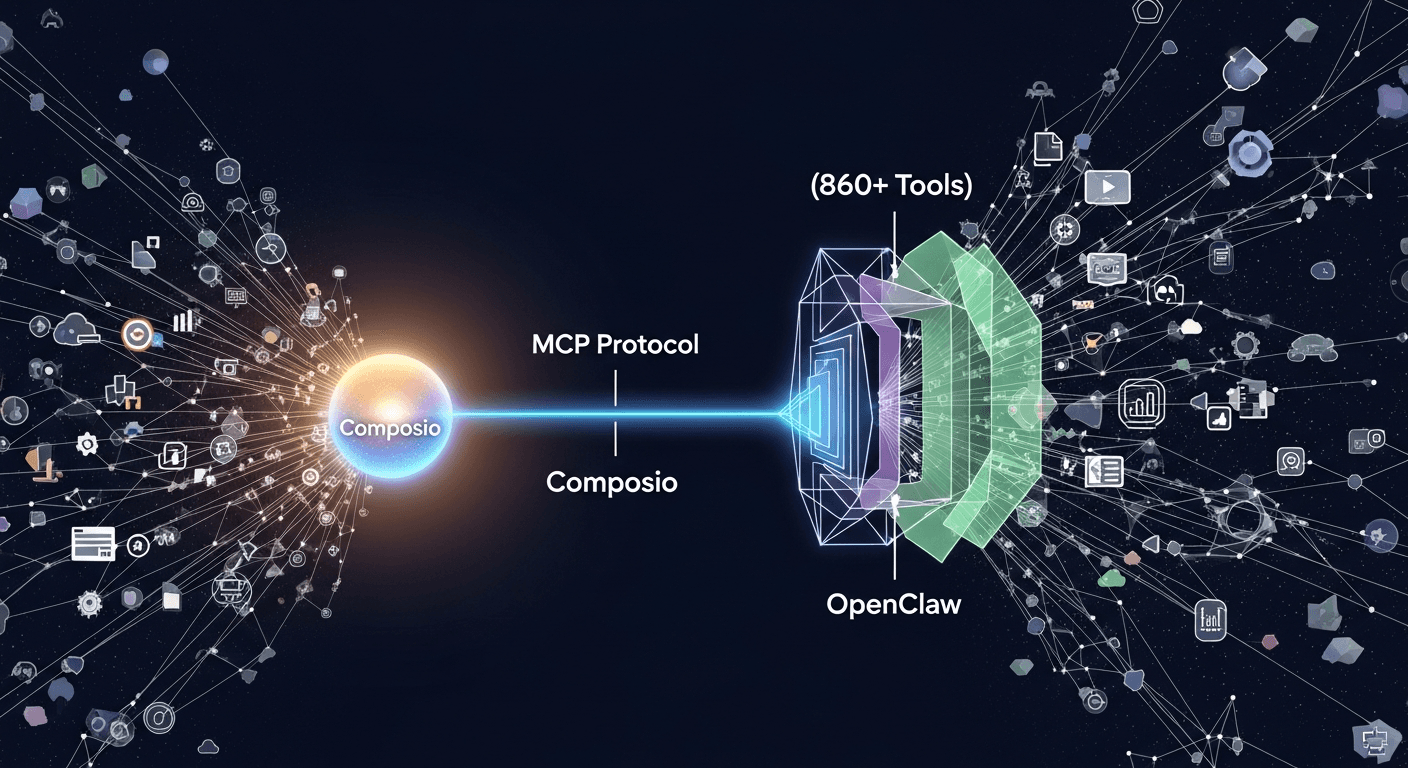
Builders using OpenClaw can now prototype and deploy multi-step workflows 5-10x faster by leveraging Composio's 860+ pre-built tool integrations instead of building custom adapters.
Signal analysis
Composio has integrated with OpenClaw through the Model Context Protocol (MCP), a standardized interface that lets AI models interact with external tools and data sources. This integration means OpenClaw users can now access Composio's 860+ pre-built tool connections without building custom adapters. MCP serves as the bridge—OpenClaw handles agent orchestration and decision-making, while Composio handles the actual tool execution.
The significance here is architectural: instead of OpenClaw users building point-to-point integrations for each tool they need, they get access to a curated library of already-functional connections. This reduces integration debt and accelerates time-to-functionality for multi-step workflows.
Building AI workflows requires more than logic—it requires functional connections to the tools your agents actually use. Most teams spend 40-60% of implementation time on integration plumbing: authentication, API handling, error recovery, rate limiting. Composio's 860+ tools abstract this away; OpenClaw users can now focus on workflow design instead of integration scaffolding.
The MCP standardization matters because it signals a market shift toward interoperability protocols rather than proprietary connectors. If MCP becomes the dominant standard (alongside similar emerging protocols), switching costs between agent frameworks decrease, and the competitive advantage moves to workflow quality, not integration lock-in.
This integration reflects a broader market consolidation around MCP. Anthropic championed MCP as an open standard; Composio and OpenClaw both adopting it signals that major tool providers view standardization as necessary for the agent economy to scale. Similar moves by other platforms will likely follow.
The real test: Does MCP become the de facto standard for agent-tool communication? If so, this release is an early indicator that the market is choosing open interoperability over closed ecosystems. If not, you're seeing two platforms making a compatibility bet that may or may not pay off.
If you're building with OpenClaw or considering it, this integration materially changes the cost-benefit analysis. You can now prototype multi-tool workflows without custom integration work. The practical move: audit your workflow requirements and check Composio's tool catalog—if 70%+ of your tools are covered, the integration value is immediate.
More broadly, this is a signal to evaluate MCP compatibility in your agent framework selection. MCP won't solve all integration problems (some tools require domain-specific logic), but it removes the low-hanging fruit. Teams that adopt MCP-compatible frameworks now avoid rebuilding integrations when standards shift.
Best use cases
Open the scenarios below to see where this shift creates the clearest practical advantage.
One concise email with the releases, workflow changes, and AI dev moves worth paying attention to.
More updates in the same lane.
The latest Cursor update enhances AI tool integration, streamlining developer workflows and increasing productivity.
Unlock new productivity with the latest Cursor update, featuring enhanced AI tools for developers.
OpenAI's recent update introduces enhanced features that streamline developer workflows and boost automation capabilities.
