Blackbox Cloud now enables simultaneous agent execution across remote environments. Builders can offload distributed work without managing infrastructure.
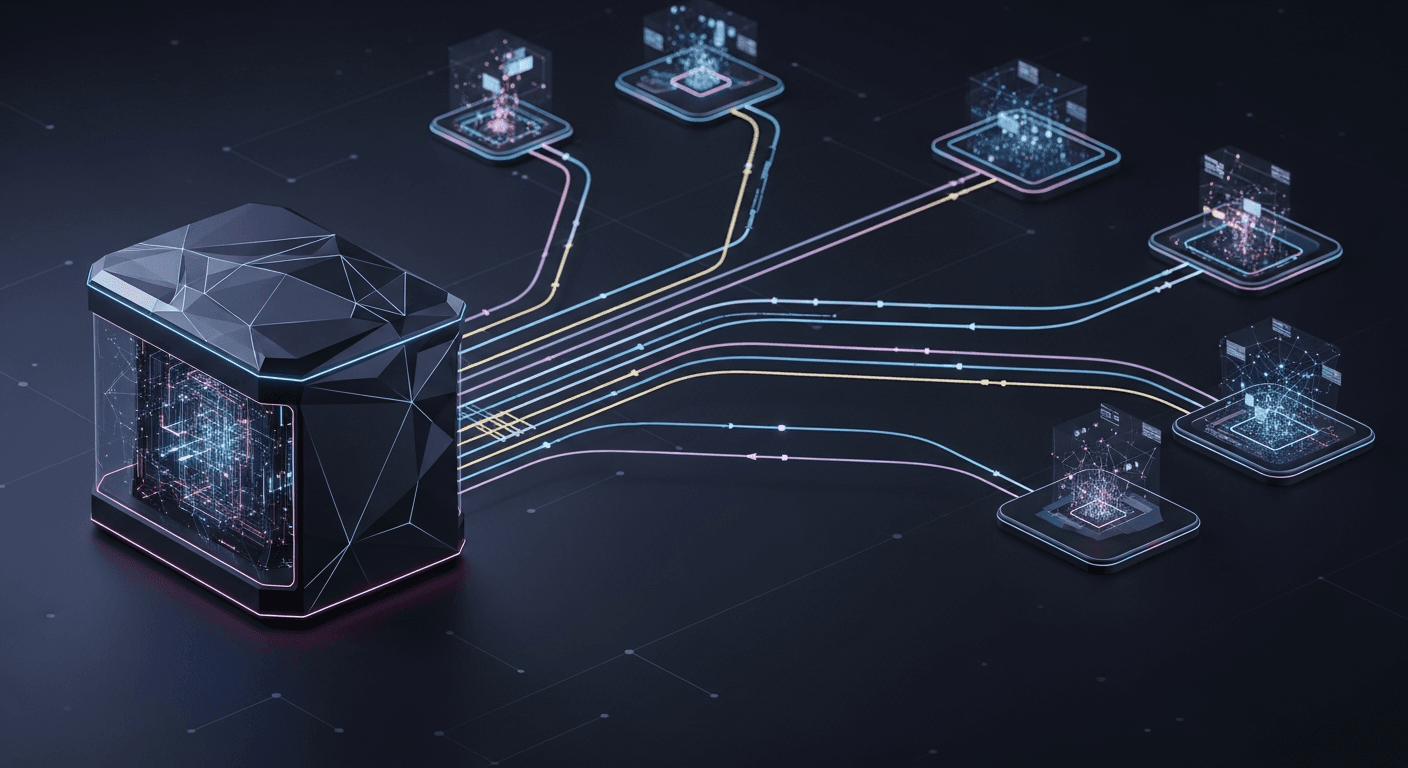
Execute multiple agent tasks in parallel on cloud infrastructure, compress development timelines, and automate PR workflows — but require upfront observability and cost planning.
Signal analysis
Blackbox introduced Remote Agent functionality through Blackbox Cloud, shifting from local-only execution to distributed task handling. This means agents can now spawn, monitor, and coordinate work across multiple remote environments simultaneously rather than sequentially on a developer's machine.
The implementation centers on three capabilities: parallel task spawning (multiple agents work concurrently), real-time monitoring dashboards (visibility into distributed work), and native PR management (agents can create, review, and manage pull requests autonomously). This removes the bottleneck of single-machine execution and dramatically compresses task completion timelines.
The architecture appears stateless and cloud-native, suggesting agents persist in cloud infrastructure rather than requiring a developer to keep a local process running. This is a material shift from agent-as-subprocess to agent-as-service.
For development teams, this is a multiplier on agent utility. Previously, using Blackbox agents meant trading off between complexity (handling async coordination) and speed (sequential execution). Remote agents remove that tradeoff. A developer can now spawn 5 agents to handle 5 different features, code reviews, documentation tasks, and test suites in parallel, with cloud infrastructure managing orchestration.
The PR management integration is operationally significant. Agents can now close the loop from task execution to code submission without developer intervention. This transforms agents from code-generation helpers into autonomous contributors that can validate their own work through CI systems.
However, this introduces new operator concerns: distributed agent coordination complexity, cost scaling with parallel execution, and observability overhead. Builders must now reason about agent concurrency patterns and cloud resource consumption.
The implicit contract shifts from 'agent helps me write code' to 'agent executes work autonomously in a distributed environment I don't directly control.' This requires different mental models around reliability, monitoring, and failure modes.
This move signals that AI agent platforms are moving beyond 'local assistant' positioning into infrastructure-as-a-service. Blackbox is betting that autonomous code execution justifies cloud infrastructure investment and per-agent or per-execution pricing models.
Competitors like GitHub Copilot Workspace, Replit Agent, and early-stage platforms are likely moving toward similar distributed execution models. The question isn't whether remote agents are viable — it's whether each platform can build trustworthy, cost-effective, and observable distributed agent systems.
From a market perspective, this validates that code generation alone is insufficient. Builders want agents that can execute, integrate, and close feedback loops. Platforms that don't offer distributed execution risk being perceived as incomplete tooling.
If you're currently using Blackbox or evaluating agent platforms, remote execution capability should now be in your evaluation matrix. Test concurrent agent spawning, monitor cloud costs, and validate that PR workflows integrate cleanly with your CI/CD systems. This isn't theoretical — concurrent agents can rapidly consume cloud infrastructure credits.
For teams considering agent adoption, this update removes a major blocker: local resource constraints. You can now reason about scaling agent work without worrying about maxing out developer machine resources. This shifts the conversation from 'can we use agents?' to 'how much distributed work should agents handle?'
Architecture your workflows to take advantage of parallelization. Instead of sequential agent tasks, design for concurrent execution. This requires thinking about agent isolation, state management, and failure recovery across distributed tasks.
Best use cases
Open the scenarios below to see where this shift creates the clearest practical advantage.
One concise email with the releases, workflow changes, and AI dev moves worth paying attention to.
More updates in the same lane.
The latest Cursor update enhances AI tool integration, streamlining developer workflows and increasing productivity.
Unlock new productivity with the latest Cursor update, featuring enhanced AI tools for developers.
OpenAI's recent update introduces enhanced features that streamline developer workflows and boost automation capabilities.
