Agenta now syncs prompt versions directly to GitHub via webhooks and automations. Here's why this matters for your LLM workflow and what you should audit today.
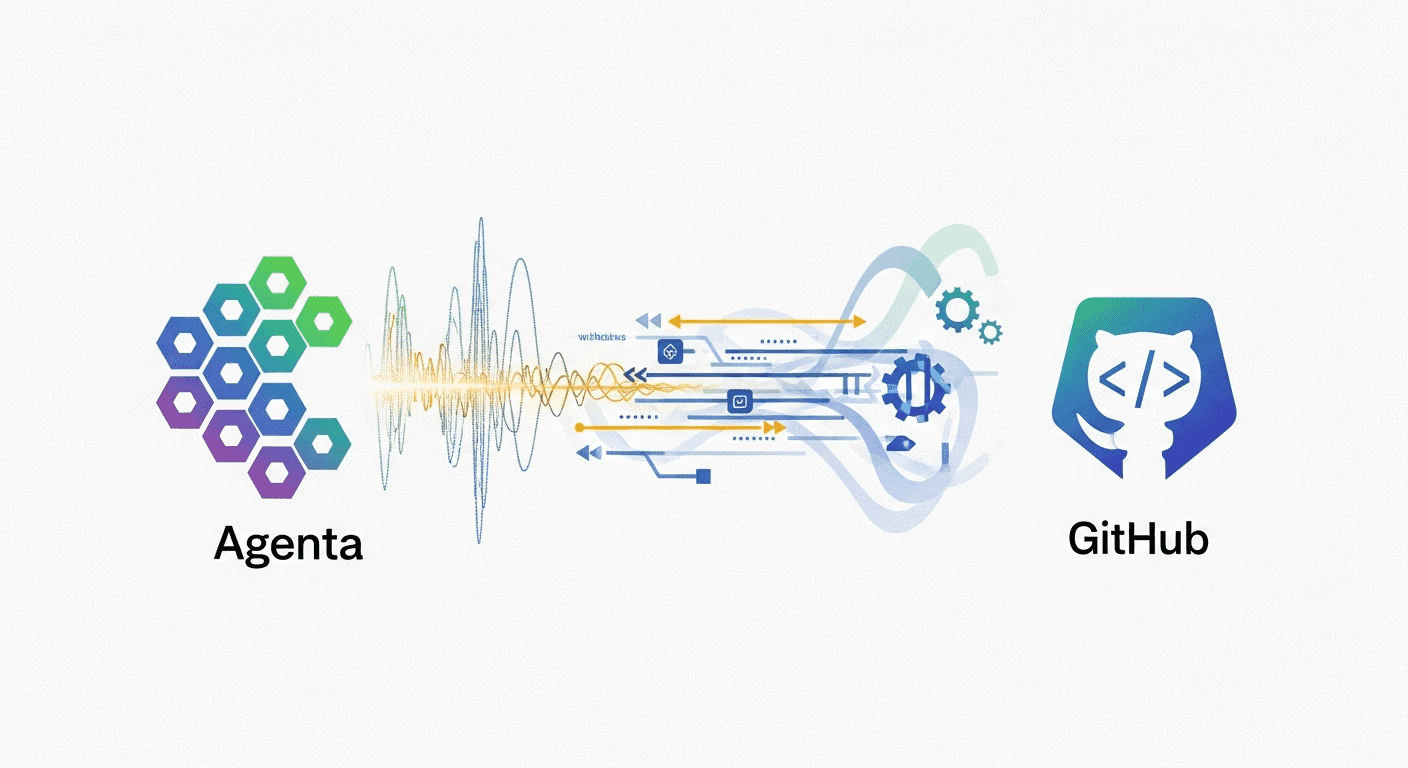
Agenta's webhooks and GitHub automations eliminate manual handoffs between prompt experimentation and production deployment, enabling centralized governance and auditable change trails for LLM applications at scale.
Signal analysis
Agenta added native webhook support and GitHub Actions integration, eliminating the gap between prompt experimentation and version control. When you save a new prompt version in Agenta, it can now automatically trigger workflows in your GitHub repository—pushing changes, creating PRs, or running downstream tests without manual handoff.
This is infrastructure-level, not UI-level. You're no longer copy-pasting prompts between tools or managing two sources of truth. The connection is bidirectional-capable: Agenta can listen for GitHub events and trigger actions within Agenta, and Agenta can push events to GitHub to kick off your CI/CD pipelines.
The webhook implementation suggests Agenta is positioning itself as a production-grade system, not a playground. Webhooks mean other tools can now subscribe to prompt changes—your monitoring stack, your logging system, your compliance audit tools.
Before this, LLM teams faced a friction point: you'd experiment in Agenta, approve a prompt, then manually commit it to GitHub or paste it into your application code. That manual step introduced lag, human error, and audit gaps. With webhooks and GitHub automations, that step disappears.
For teams running multiple LLM applications, this becomes a centralized control layer. One prompt repository in Agenta, distributed to all your applications via GitHub. One version history. One approval gate. This is especially valuable if you're managing prompts across staging and production environments—you can now enforce CI/CD discipline on prompts the same way you do for code.
The compliance angle matters too. Regulated industries (fintech, healthcare, enterprise SaaS) need audit trails for every change. GitHub commit history + Agenta's version control + webhook logs = auditable chain of custody for your prompts.
This move signals that Agenta is competing on operational maturity, not novelty. They're not adding flashy features—they're filling gaps in enterprise workflows. Webhooks and GitHub integrations are table stakes for any tool that wants to live in a production deployment pipeline.
You're seeing the same pattern across the LLM tooling space: Anthropic's Batch API, Langfuse's integrations, and now Agenta's webhook infrastructure. These are all moves toward treating prompts like versioned, deployable artifacts. The market is moving past 'prompt playground' toward 'prompt as code.'
This also suggests Agenta is optimizing for team-based development, not solo experimentation. GitHub integration is a team feature. Webhooks are infrastructure features. The message: Agenta is for teams building LLM applications at scale, not individuals prototyping.
If you're already using Agenta, audit your current prompt deployment workflow. Where are the manual handoffs? Where are the delays? Map those friction points to the webhook + GitHub automation capabilities now available. Prioritize the bottlenecks that cost you the most latency or create the most error surface.
If you're evaluating prompt management tools, GitHub integration is now a baseline requirement, not a differentiator. Ask every vendor: Can you push to GitHub? Can you listen for GitHub events? Can you integrate with our CI/CD pipeline? Agenta just answered all three—your other tools need to match.
For teams with strict governance requirements, this is an opportunity to consolidate your prompt audit trail. If you're currently splitting prompts between multiple tools or maintaining separate version histories, consolidating on Agenta + GitHub gives you one source of truth and one audit log.
Best use cases
Open the scenarios below to see where this shift creates the clearest practical advantage.
One concise email with the releases, workflow changes, and AI dev moves worth paying attention to.
More updates in the same lane.
The latest Cursor update enhances AI tool integration, streamlining developer workflows and increasing productivity.
Unlock new productivity with the latest Cursor update, featuring enhanced AI tools for developers.
OpenAI's recent update introduces enhanced features that streamline developer workflows and boost automation capabilities.
