
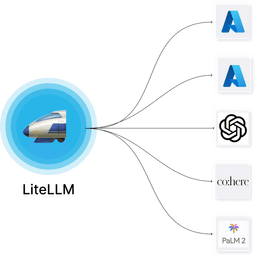
LiteLLM
Open-source AI gateway and proxy. Call 100+ LLM APIs in the OpenAI format with load balancing, fallbacks, and spend tracking.
100+ LLMs unified interface
Last updated
Recommended Fit
Best Use Case
Developers building applications that need to work with multiple LLM providers without rewriting code for each API, or teams that want to optimize costs by intelligently routing requests across cheaper or faster models dynamically.
LiteLLM Key Features
100+ LLM API compatibility
Call any of 100+ language models using OpenAI-compatible format, including models from Anthropic, Cohere, Replicate, Together AI, and more. Drop-in compatibility with existing OpenAI integrations.
AI Gateway
Intelligent load balancing
Distribute requests across multiple models or providers based on custom rules. Optimize for cost, latency, or model quality automatically.
Fallback and retry mechanisms
Spend tracking and cost control
Monitor token usage and costs across all LLM providers in real-time. Set budgets and alerts to control spending on API calls.
LiteLLM Top Functions
Overview
LiteLLM is an open-source AI gateway that abstracts away the complexity of managing multiple large language model APIs. It standardizes calls to 100+ LLM providers—including OpenAI, Anthropic, Cohere, Replicate, and lesser-known alternatives—into a single OpenAI-compatible API format. This eliminates vendor lock-in and allows developers to switch between models or providers without rewriting application code, making it invaluable for production systems requiring resilience and cost optimization.
The tool operates as a lightweight proxy layer that handles authentication, request formatting, response normalization, and monitoring. Developers can deploy LiteLLM locally, on Docker, or as a managed service, then route all LLM calls through it. This centralized approach creates a single point of control for tracking spend, implementing rate limits, and managing model routing policies across an entire organization or application.
Key Strengths
LiteLLM's most powerful feature is intelligent load balancing and automatic fallback routing. If your primary model (e.g., GPT-4) hits rate limits or fails, requests automatically route to a secondary provider without application-level retry logic. You can define weighted pools of models, enabling cost-conscious routing: send 70% of traffic to cheaper Claude instances and 30% to GPT-4 for complex tasks. This dramatically reduces API costs while maintaining quality.
- Built-in spend tracking per model, user, and API key—essential for chargeback and cost allocation in multi-tenant systems
- OpenAI-compatible API format means existing code using Openai-python or LangChain requires minimal changes (often just one line to point at the LiteLLM proxy)
- Support for streaming, function calling, vision models, and embeddings across all 100+ providers with normalized request/response schemas
- Easy integration with monitoring tools (DataDog, New Relic) and logging frameworks for production observability
Who It's For
LiteLLM is ideal for teams building production AI applications that require multi-model flexibility, cost control, and high availability. Startups can use it to evaluate multiple LLM providers without committing to one vendor, while enterprises appreciate centralized spend tracking and compliance logging. Development teams already using LangChain, LlamaIndex, or direct OpenAI SDKs can adopt LiteLLM incrementally—often with zero application changes.
However, it's less suitable for single-model scenarios (e.g., a company standardized entirely on GPT-4) or teams without DevOps capacity to manage a proxy infrastructure. Smaller projects with minimal spend tracking requirements may find the setup overhead unnecessary.
Bottom Line
LiteLLM solves a critical problem in modern AI development: the fragmentation of LLM APIs and the need for intelligent routing, cost control, and high availability. Its open-source nature, free tier, and OpenAI-compatible design make it an exceptionally low-risk addition to any LLM-powered stack. For teams managing multiple models or providers, it typically pays for itself in operational efficiency within weeks.
LiteLLM Pros
- Standardizes calls to 100+ LLM APIs into OpenAI-compatible format, eliminating vendor lock-in and reducing code rewrites when switching models.
- Intelligent load balancing and automatic fallback routing ensure high availability—if GPT-4 rate-limits, traffic automatically routes to Claude or other fallback models without application changes.
- Built-in spend tracking by model, user, and API key provides granular cost visibility across multi-tenant systems and enables accurate chargeback.
- Completely free and open-source, eliminating recurring licensing costs and allowing full control over proxy infrastructure and customization.
- OpenAI SDK compatibility means integrating with LangChain, LlamaIndex, and existing applications requires minimal code changes—often just one line to point the base_url.
- Weighted model routing enables cost optimization by directing high-volume requests to cheaper alternatives (e.g., Claude Haiku) while reserving expensive models (GPT-4) for complex tasks.
- Streaming, function calling, vision, and embeddings are supported across all providers with normalized request/response schemas for consistent application behavior.
LiteLLM Cons
- Requires DevOps infrastructure setup and maintenance—deploying and managing a proxy server adds operational overhead that small teams may not have capacity for.
- Documentation, while improving, can be sparse in places and may require reading source code to understand advanced routing or custom provider configurations.
- Community support is limited compared to commercial API gateways; production issues may require self-troubleshooting or GitHub issues that take time to resolve.
- Performance overhead from the proxy layer adds latency to every request; latency-sensitive applications (sub-100ms requirements) should benchmark carefully.
- Some newer or niche LLM providers may have incomplete support, requiring workarounds or custom integration code rather than out-of-the-box compatibility.
- Error handling and debugging can be complex when routing across multiple providers with different error schemas; standardization helps but edge cases remain.
Get Latest Updates about LiteLLM
Tools, features, and AI dev insights - straight to your inbox.


